Improved lyocell dissolving system
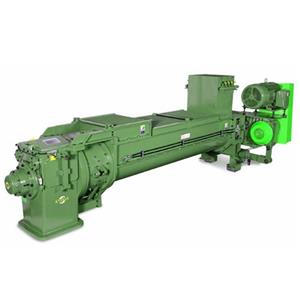
Lyocell fiber technology aims to convert cellulose into a man-made, cotton-like fiber. The lyocell process involves a series of processing steps, with the dissolution step being the most critical. A kneader developed by KaiZheng has been successfully applied in the continuous dissolution stage, enabling the treatment of raw materials from various sources and their conversion into spinnable dope.
The Lyocell dissolution system is part of solvent-spun fiber technology for natural raw materials. Currently, two process options are available.
Two-step process
This two-step continuous process consists of a pre-mixing step and a dissolution step. In the pre-mixing step, cellulose is mixed with solvent and homogenized to swell the pulp. The dissolution step converts the pulp into a dope suitable for wet spinning.
One-step process
This one-step process meets the demand for small quantities of specialty spinning solutions required for fine yarns, films, and special technical applications. In a single unit, cellulose is mixed, homogenized, and dissolved. Additives can also be introduced during this process to produce modified pastes with specific properties. A recent innovation is the continuous pulp pre-mixer. The main advantage of introducing the pre-mixer is enabling a continuous process flow, ensuring uniform pulp quality without interruptions. Another innovation from Kai Zheng is the pulp feeder, which ensures precise delivery of pulp into the vacuum environment of the reactor. The feeder is vacuum-sealed and features a long service life. To prevent leakage of the discharged slurry from the reactor, an advanced discharge system has been developed. This system transports the slurry via pressurized piping and degasses it to achieve bubble-free spinning.
The benefits of this process
KaiZheng uses different raw materials to produce high-quality artificial short fibers, foil materials, fine yarns and films. Its feature is a high solvent recovery rate. The shear rate, expansion/dissolution time can be adjusted according to the source of raw materials. This enables the conversion of low-cost raw materials into high-quality short fibers, similar to cotton.